Bien-Air’s integrated anti-retraction valve helps reduce that backflow close to the treatment site—adding an important safeguard without adding another step to the clinical workflow.
A handpiece is connected to more than a bur. It is also connected to the dental unit’s air and water systems. Reducing the backward movement of oral fluid helps protect the parts of that system that cannot simply be placed in an autoclave.
Watch how the anti-retraction valve helps limit backward fluid movement toward the dental unit.
A high-speed handpiece combines a rotating bur with air and cooling water. At the treatment site, that spray can mix with saliva, blood, tooth material, and microorganisms. Some of the resulting droplets may remain close to the patient as splatter, while smaller droplets may travel through the operatory as aerosol.
High-volume evacuation, thoughtful positioning, personal protective equipment, ventilation, and established infection-control procedures all play a role in managing what leaves the treatment site.
Here is the key distinction: aerosol moves away from the treatment site. Retraction moves in the opposite direction—back into the handpiece.
When a handpiece stops, a brief pressure change may allow fluid from the patient’s mouth to be pulled backward into the instrument. Without effective anti-retraction protection, that material may move beyond the handpiece and toward dental unit tubing or waterlines that cannot be sterilized between patients.
This does not mean aerosol and retraction are unrelated. Both can involve oral fluids and microorganisms. They are, however, different events—and they require different safeguards.
Managed with clinical controls such as high-volume evacuation, PPE, positioning, ventilation, and appropriate infection-control procedures.
Reduced with anti-retraction technology designed to limit backward fluid movement toward the dental unit.
During treatment, cooling water flows toward the bur and the treatment site. When the handpiece stops, the Bien-Air anti-retraction valve helps prevent oral fluid from traveling backward through the instrument.
The valve is small and works quietly in the background. Its purpose is straightforward: help reduce the risk of patient material entering the dental unit’s non-sterilizable hoses and waterlines.
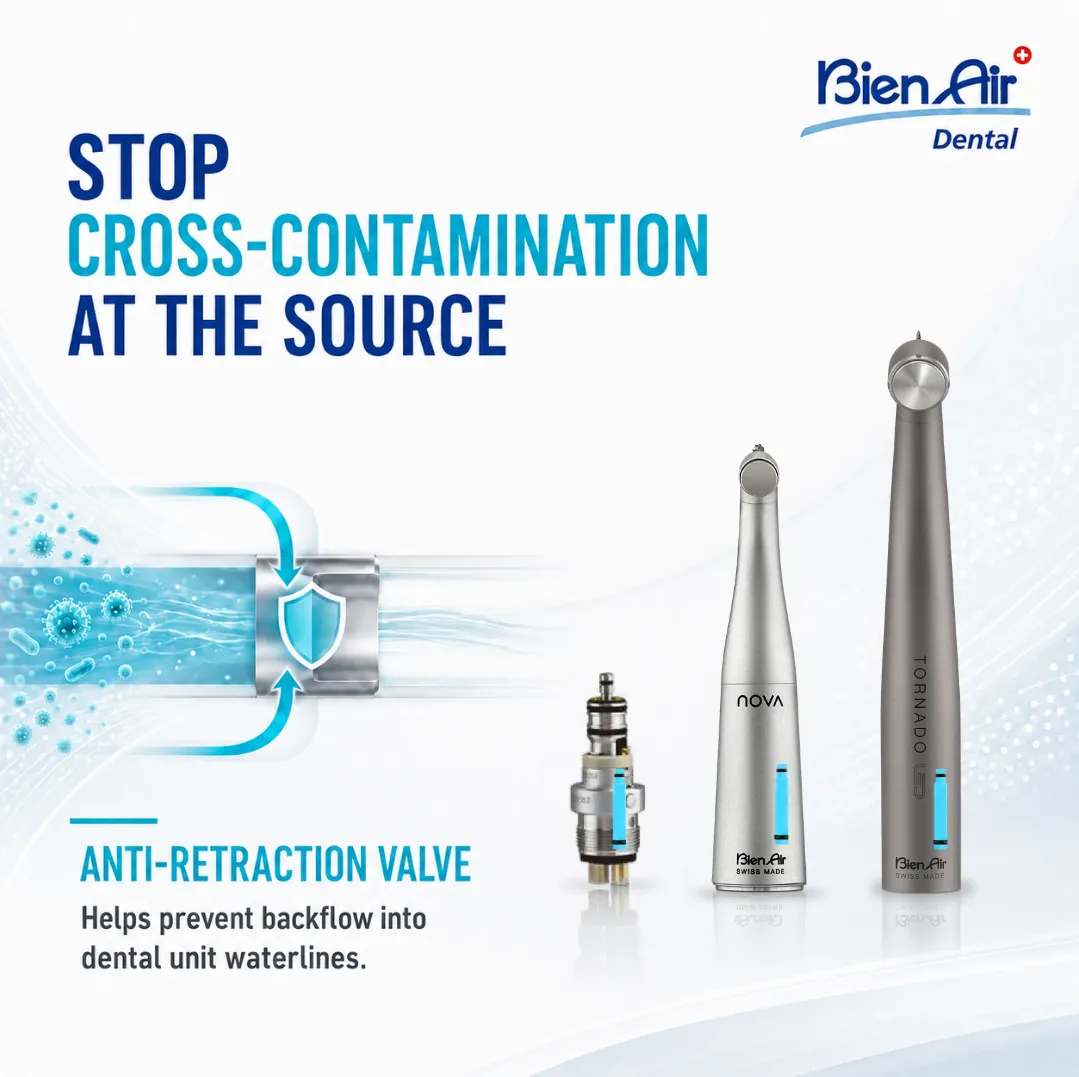
Bien-Air places the anti-retraction valve inside the body of compatible handpieces and attachments. This positions the safeguard close to the treatment site, before retracted fluid can move farther toward the dental unit.
Because it is part of the instrument, the valve is processed with the handpiece when the device is cleaned and sterilized according to the current Bien-Air instructions for use.
An anti-retraction valve does not eliminate dental aerosols, sterilize dental unit waterlines, or replace the infection-control procedures already used in your practice. It addresses one specific concern: the backward movement of oral fluid into the handpiece and toward the dental unit.
Like any precision component, an anti-retraction valve must remain clean and functional. Clean, lubricate when required, package, and sterilize each handpiece according to the instructions for its specific model. Avoid unapproved products or processing methods that could damage internal components.
If spray performance changes or an instrument does not function normally, remove it from service and have it evaluated by an authorized service provider.
Infection prevention is also part of handpiece performance.
The anti-retraction valve may be small, but it supports an important separation between the patient’s mouth and the dental unit.
Discover turbines, electric attachments, and couplers that combine precision, ergonomics, and integrated anti-retraction protection.