
☰ Menu
× Close

All Speed Red

curve

← Back to Blog

Clinical Performance
One Handpiece. All Speeds.

When you pair the CA NOVA 1:5 “High Speed” attachment on a Bien-Air electric motor system, you no longer need a slow speed. Find out how Dr. Marc Lai simplifies this advantage even further, relying on “five speeds” for all his restorative procedures.

LinkedIn Facebook

NOVA 1:5 + MCX/MX2 electric motor system All Speed Red

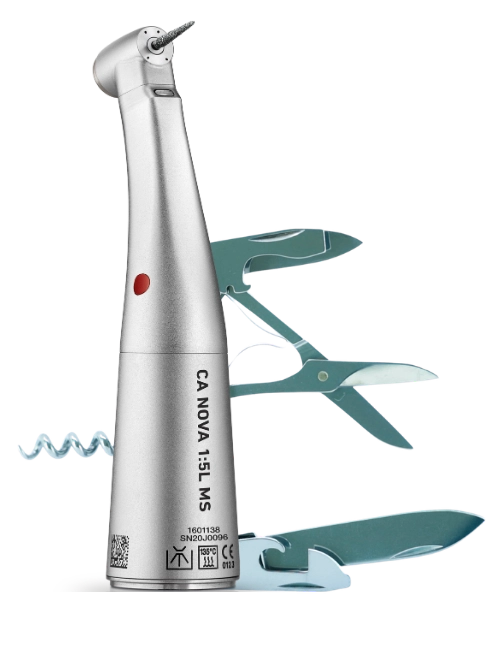
Bien-Air NOVA 1:5 illustrated as a Swiss Army knife to show its versatility

Think of the NOVA 1:5 as the Swiss Army knife of handpieces: one handpiece for multiple clinical jobs, simply by changing the speed.

Why this matters
What if the handpiece you use at high speeds could also be the handpiece you use at slow speeds?

High speed and slow speed are often treated as two separate parts of the operatory workflow. Dr. Marc Lai takes a different approach: he uses one NOVA 1:5 across five working speeds, from tooth preparation to polishing and even deep caries removal.

With the All Speed Red NOVA 1:5 and on a Bien-Air electric motor system, you can change speed without having to change the handpiece. This means less inventory, less maintenance and repairs, and more money saved.

Simplifying the electric workflow Dr. Marc Lai demonstrates how one NOVA 1:5 can support clinical steps from 200,000 RPM down to 5,000 RPM.

First, what does 1:5 ratio actually mean?

The red dot on the NOVA identifies a speed-increasing 1:5 contra-angle. The handpiece multiplies the rotation of the bur via the electric motor, allowing the bur to reach high-speed operating ranges. Here’s the kicker: when you multiply the speed by 5, you have to divide the torque by the same number. For our competitors, this means that you may lose the necessary torque needed to do slow speed procedures with a high speed handpiece. Not with Bien-Air. Our patented smart logic system gives you the necessary torque needed to do slow speed procedures with a high-speed handpiece.

That is why it is useful to think of the NOVA 1:5 as more than simply a “High-Speed” handpiece. Paired with the right Bien-Air electric system and slow speed friction grip burs, it becomes the All Speed handpiece.

Here is the key distinction: The High Speed becomes an All Speed handpiece when it’s paired with a Bien-Air electric system and slow speed, friction grip burs (which are available by popular bur manufacturers).

Five speeds. One NOVA.

Dr. Lai describes himself as a “five-speed kind of guy.” Rather than treating the NOVA 1:5 as a single-speed instrument, he changes the speed to match what he is doing clinically.

200K RPM
Tooth preparation Dr. Lai’s highest setting for reducing a tooth for an indirect restoration.

100K RPM
Refinement & polishing Used for refinement and, in his workflow, polishing composite or a bis-acryl temporary.

50K RPM
Ceramic adjustment Used by Dr. Lai when adjusting or polishing ceramic, with generous water spray.

10K RPM
Preparation refinement Part of the lower-speed range he uses for refining a preparation, including dry use without water spray.

5K RPM
Deep caries removal His lowest setting, using a friction-grip round bur in place of a separate slow-speed attachment.

The speed comes from the system

Ultimately, you control the speed based on what feels right. Bien-Air’s electric motor systems gives you the freedom to choose your speed easily and efficiently, regardless of what system you’re using.

Traditional workflow
Change the attachment

High-speed and slow-speed applications are commonly handled with different handpieces or attachments.

All Speed Red workflow
Change the speed

Dr. Lai keeps the NOVA 1:5 in hand and changes motor speed as he moves from one clinical task to another.

Think beyond “high speed” and “slow speed”

The practical idea behind All Speed Red is simple: speed becomes a setting rather than a reason to automatically reach for another attachment.

Same NOVA 1:5 Change motor speed Keep working

Why electric makes the difference

Dentistry rewards precision. An electric motor gives you power and control to perfect your preps. Bien-Air takes it one step further with our patented smart logic system. That technological feat is what makes Dr. Lai’s five-speed workflow possible: he can move from aggressive preparation to refinement, polishing, and caries removal without treating every step as a separate handpiece category using slow speed, friction grip burs.

The All Speed Red approach
Five clinical speeds. One NOVA.

Instead of changing handpieces as the clinical task changes, Dr. Marc Lai changes the motor speed—keeping the same NOVA 1:5 in hand from preparation through refinement and deep caries removal.

From 5,000 to 200,000 RPM in Dr. Lai’s workflow
Discover All Speed Red

Explore the NOVA 1:5 and Bien-Air electric systems that bring high-speed performance and controlled lower-speed workflows together.

Explore NOVA 1:5 Explore Electric Motors

Clinical techniques and speed selections shown here reflect Dr. Marc Lai’s workflow as described in the featured video. Follow the current Bien-Air instructions for use and the instructions provided for the burs, restorative materials, and other clinical products used in each procedure.

Stay informed
Keep learning with Bien-Air.

Subscribe for practical dental education, clinical workflow ideas, product news, event updates, and occasional insights from Bien-Air USA.

✓ Helpful education ✓ Occasional emails ✓ Unsubscribe anytime
Name(Required)
Consent